DEA GEMINA (Tabula Bifrons)
> about the image:
Duo sunt in me, et ambae verae.
(two dwell in me, and both are true – fragmentum apocryphum)
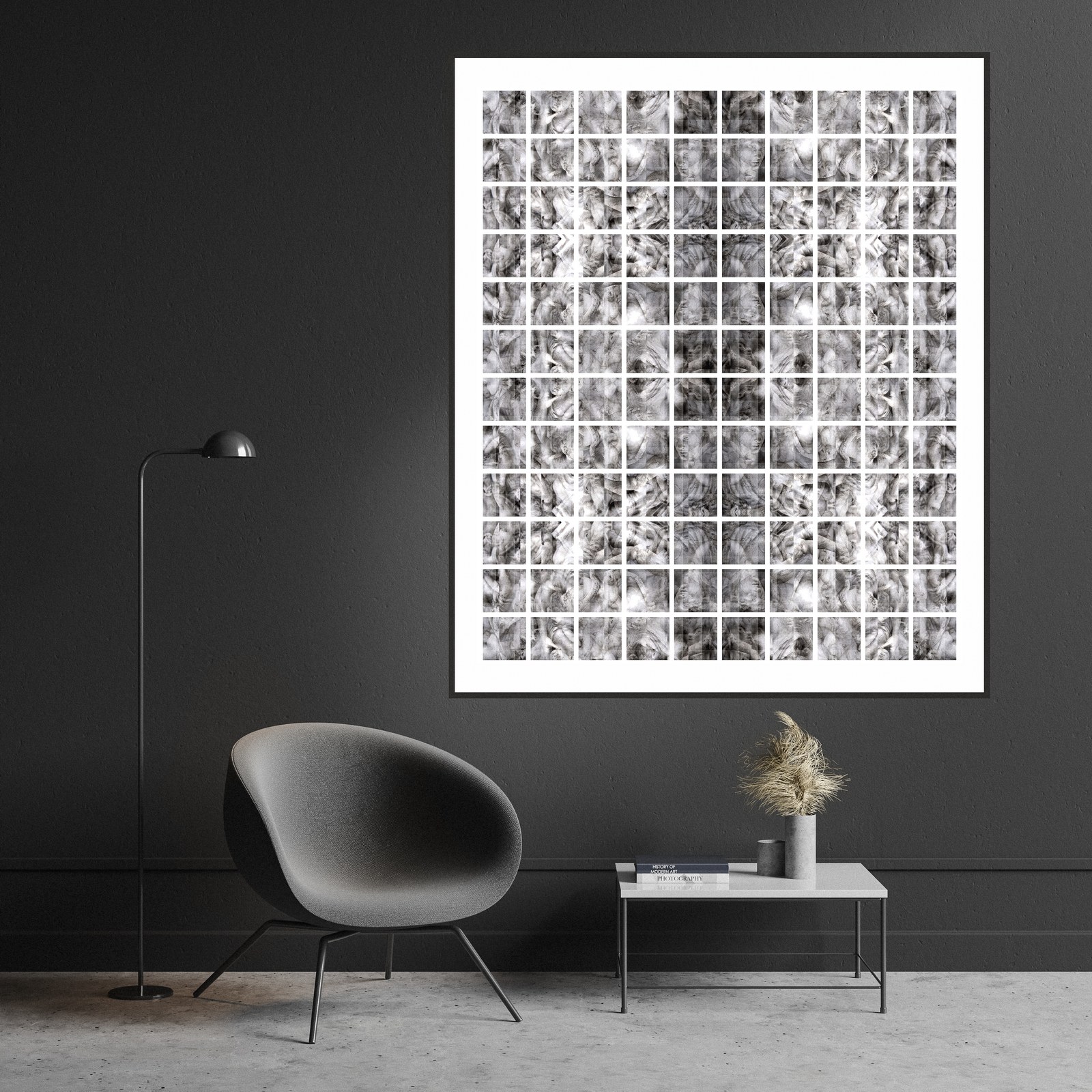
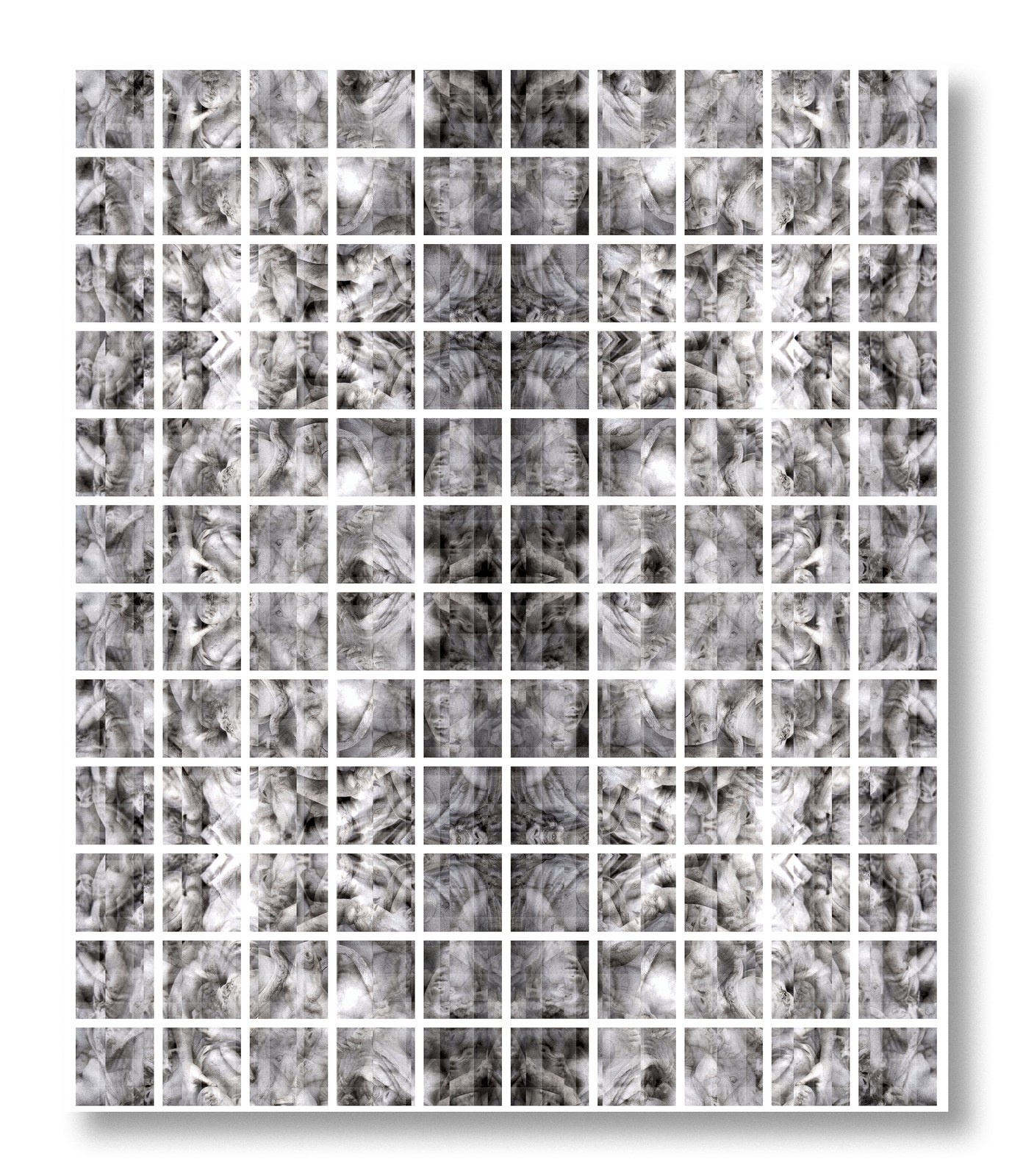
DEA GEMINA (Tabula Bifrons) stages the mythic figure of the “double goddess” as both visual apparition and psychoanalytic construct. The work is built on a strict white grid, yet what inhabits that grid is unstable: a two-headed, bifrontal presence that oscillates between recognition and dissolution. The classical relief has been digitized, fragmented, multiplied, and reassembled into a tiled matrix where every square behaves like a small, disturbed mirror. The title invokes a speculative feminine counterpart to Janus Bifrons and quietly resonates with figures such as Hecate Triformis, the threshold goddess of crossroads and liminal spaces. Here, however, the goddess is not depicted in a conventional mythological pose. She emerges through accumulation: faces that almost coincide along the central axis, doubled torsos, mirrored profiles that never perfectly align. The grid organizes these fragments into a “tabula” – a chart, a diagnostic plate, a specular diagram of a psyche that does not resolve into a single self. Crișan’s architectural training is legible in the modular logic of the composition. The grid promises order, legibility, even control, as in a façade study or a measured drawing. But within each cell, the image behaves otherwise. Bodies are blurred, overlaid, partially rotated; gestures repeat with slight variations, producing a low-frequency vibration across the surface. The viewer’s eye begins to navigate horizontally and vertically, seeking continuity from one square to the next. What results is a form of visual analysis that never quite stabilizes. The goddess is always almost there, articulated by the sum of fragments and yet constantly slipping away. This structure invites a psychoanalytic reading. The piece recalls the specular field of Lacan’s mirror stage, where the subject discovers itself as an image that is both “me” and “other.” In DEA GEMINA (Tabula Bifrons), the double goddess functions as an allegory of that split: the self seen from two incompatible perspectives, conjoined yet divergent. The grid becomes a device for mapping this disjunction. Instead of delivering a unified portrait, it exposes the processes of identification, projection, and misrecognition that underlie any attempt to see oneself – or the divine – as one. Within the broader project of Fragmenta Deorum, this work also continues the series’ archaeology of mythic bodies. Classical sculpture, once a guarantor of stable form, appears here as a field of negotiations: between sacred and profane, masculine and feminine, interior and exterior. The erotic undercurrent is present but diffused; touches, curves, and exposed torsos appear inside the squares, yet no single scene can be isolated. Desire is distributed across the grid, echoing the way religious and psychological projections diffuse themselves across cultural images. DEA GEMINA (Tabula Bifrons) thus operates simultaneously as icon and instrument. It offers a contemporary icon of a two-headed goddess, but it also functions as a tool for thinking about doubling, dissociation, and the impossibility of a fully coherent self. The divine here is not an external guarantor of unity; it is the very form of our internal division, held in place by a fragile matrix of fragments.
> series statement:
FRAGMENTA DEORUM reexamines classical mythology through a contemporary process of visual decomposition and reassembly. In this series, Alexandru Crișan approaches the divine body not as a fixed icon but as a mutable structure – an image that can be dismantled, reorganized, and reanimated through the logic of the fragment. Trained as an architect, Crișan adopts an analytical method in which sculpture becomes material, symmetry becomes strategy, and the image behaves like a spatial system rather than a narrative scene. Each work operates within a field of controlled instability. Fragments of ancient reliefs, gestures, and anatomical details are multiplied and recomposed into new configurations where recognition and uncertainty coexist. These images provoke pareidolia: faces emerge where none were placed, mythic creatures surface from folds of marble, and bodies appear to oscillate between coherence and dissolution. Meaning does not reside in any single element but in the shifting relations among them. The series engages mythology as a psychological reservoir rather than a storytelling device. Echoes of Greek and Roman deities – Medeia, Hecate, Cassiopeia – are not depicted but inferred, surfacing through repetition, distortion, and dream-like recombination. This oneiric dimension aligns the work with psychoanalytic readings of the image, where memory, desire, and symbolic residue intertwine. The divine re-enters contemporary vision not as a stable figure but as an afterimage: a structure of intimation, erosion, and metamorphosis. FRAGMENTA DEORUM proposes that fragmentation is a generative force. Through decomposition, the sacred is not lost but redistributed; through recomposition, myth becomes newly legible. Each artwork stands as a contemporary relic, a threshold where architecture, mythology, and the unconscious converge. Crișan’s images reveal that the gods persist – not in their intact forms, but in the fragments through which they continue to speak.
> project page: FRAGMENTA DEORUM

> Special Large Collector’s Edition of 10, numbered from 1/10
> Format SL1 90CM, SL2 120cm, SL3 150cm on shortest edge
> “DEA GEMINA (Tabula Bifrons)” is available for purchase in one unique Art Limited Collector’s Edition of 10 and 2 Artist’s Proofs, in giclee archival art print at the highest museum quality standards, on Fine Art cotton paper from Hahnemuhle with pigment ink. The Collector’s Editions are certified signature editions, stamped and numbered on the back side. Additionally, as a separate document, a dedicated signed Certificate of Authenticity, with artwork title, date and edition number, indicate that you have purchased an original exclusive artwork. No further reproduction of any kind will be run after the collector edition is sold out. The prices for Special Large Collector Editions are progressive. For other detailed information’s see the section ART PRINTS.
Copyright © 1996-2026 Alexandru Crisan. All Rights Reserved. All photographs are the property of Alexandru Crisan. No part of the photographs or texts presented on this website may be reproduced, stored or transmitted in any form for any purpose whatsoever, whether by electronic media, photocopy, or any other means of reproduction without the written permission and/or signed consent of the author. Please read TERMS OF USE.