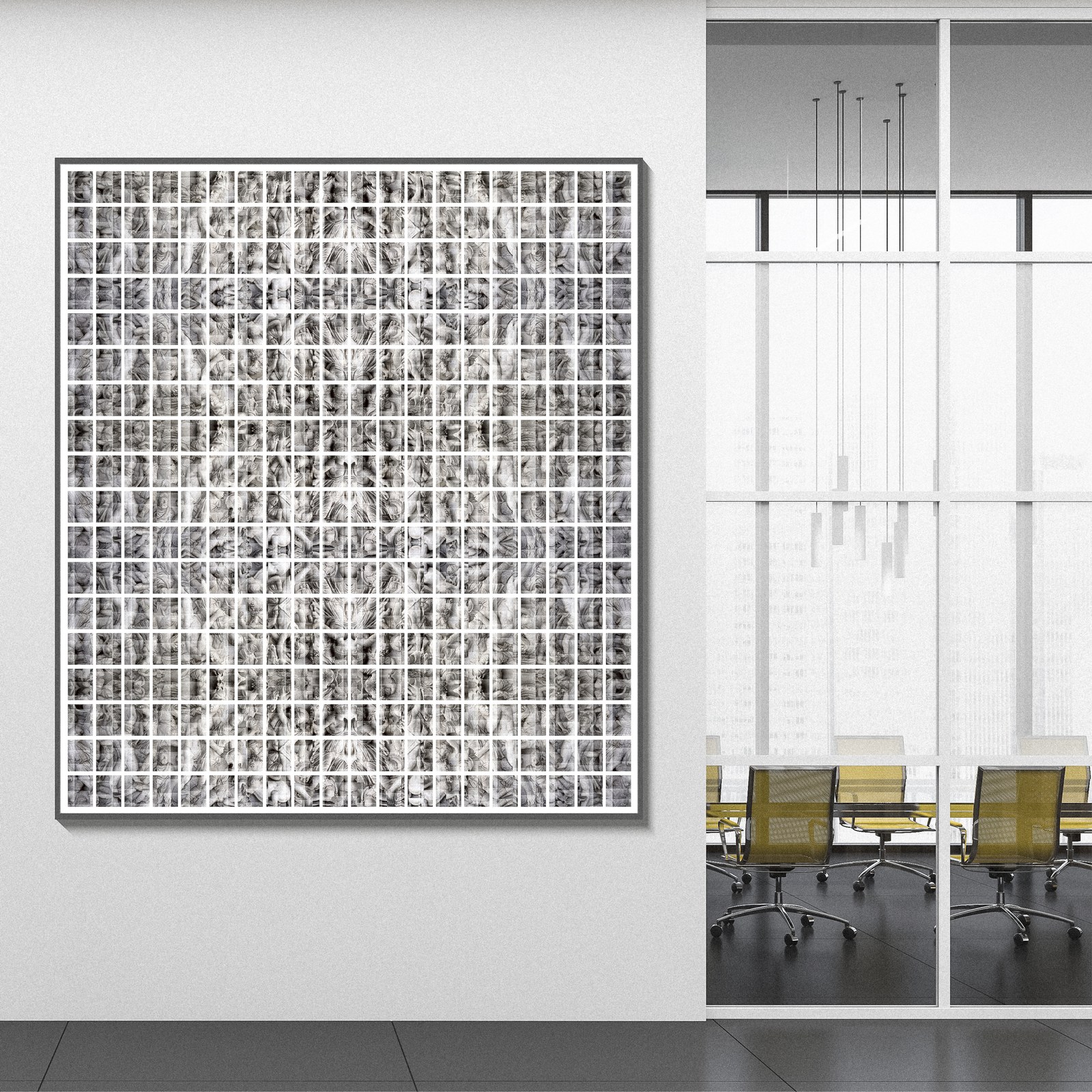

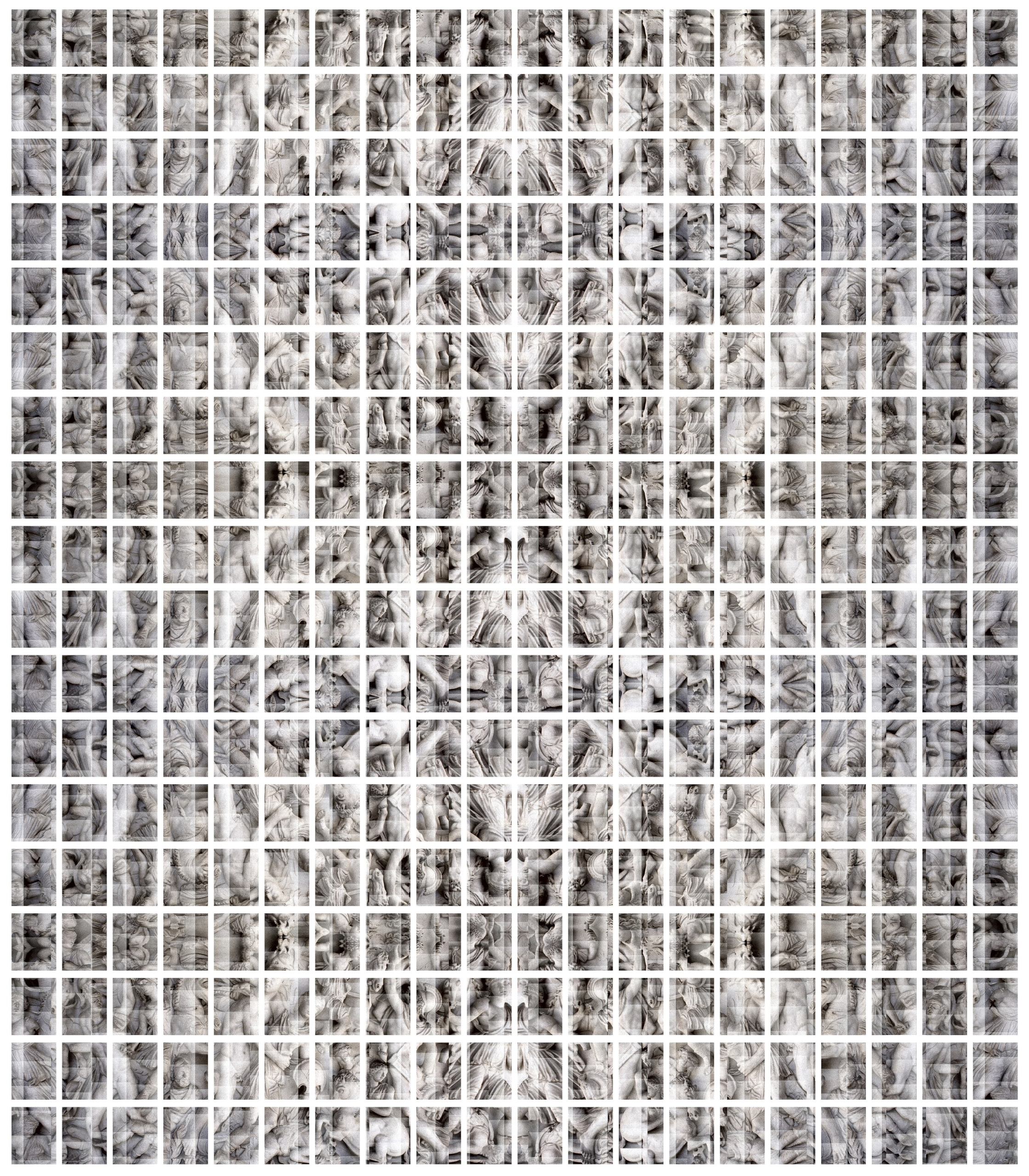
ILIAS (Tabula Heroica)
> about the image:
Arma virumque redeunt in somnis.
(the arms and the man return in dreams – fragmentum posthomericum)
In ILIAS (Tabula Heroica), Alexandru Crișan treats the Trojan War not as a linear tale of siege and vengeance, but as a psychic field – an epic compressed into a single visual plane. The work arranges recomposed fragments of classical relief into a dense, gridded cartography, where war is no longer narrated but mapped. Instead of following Homer’s verses from ship to shore, from rampart to plain, the viewer confronts an all-at-once architecture of conflict: a “table of heroes” in which shields, bodies and gestures have been dissolved into a modular, rhythmic lattice. The grid invokes the rationality of strategy: plans, deployments, formations, the abstract thinking of commanders and architects of war. Yet this rational surface is constantly disrupted by the intensity of the fragments it holds. Within each cell, traces of impact, supplication, charge and collapse flicker at the edge of legibility. Author’s training as an architect is evident in the control of repetition and alignment, but the work refuses to resolve into a stable diagram. It behaves more like a memory palace after catastrophe-ordered in principle, unstable in experience. From a psychoanalytic perspective, the piece can be read as an image of repetition compulsion. The scenes of attack, defense and intertwined bodies do not unfold; they recur. The eye moves across them the way the mind returns, obsessively, to unresolved scenes. Freud’s insight that trauma is lived belatedly finds here a visual analogue: the war has already happened, but its echo continues to organize perception. Lacan’s notion that the subject is “spoken” by the symbolic order is mirrored by the way the figures are caught in the grid’s logic, endlessly replaying their gestures inside an imposed structure. At the same time, ILIAS (Tabula Heroica) engages with the long afterlife of Homeric imagery in Western art. The heroic nude, the rearing horse, the shield as emblem of both protection and exposure – these are not simply quoted; they are folded into a new syntax. The work acknowledges how the Trojan cycle has provided, for centuries, a vocabulary for thinking about power, desire, loss and divine interference. But instead of illustrating episodes, the author lets the motifs collide. The divine and the human, the glorious and the abject, occupy the same level of the image, flattened into a shared, shimmering skin of marble. The dream logic central to the Fragmenta Deorum series is fully present here. The composition is not designed to be “read” from left to right or top to bottom; it is entered. Pareidolia becomes a method of viewing: faces emerge where there are none, shields turn into eyes, horses into vortices of motion. The work offers no single hero, no privileged vantage point, only the continuous murmur of myth under pressure. The epic survives, but in the form of fragments that require the viewer’s participation to cohere into meaning.
> series statement:
FRAGMENTA DEORUM reexamines classical mythology through a contemporary process of visual decomposition and reassembly. In this series, Alexandru Crișan approaches the divine body not as a fixed icon but as a mutable structure – an image that can be dismantled, reorganized, and reanimated through the logic of the fragment. Trained as an architect, Crișan adopts an analytical method in which sculpture becomes material, symmetry becomes strategy, and the image behaves like a spatial system rather than a narrative scene. Each work operates within a field of controlled instability. Fragments of ancient reliefs, gestures, and anatomical details are multiplied and recomposed into new configurations where recognition and uncertainty coexist. These images provoke pareidolia: faces emerge where none were placed, mythic creatures surface from folds of marble, and bodies appear to oscillate between coherence and dissolution. Meaning does not reside in any single element but in the shifting relations among them. The series engages mythology as a psychological reservoir rather than a storytelling device. Echoes of Greek and Roman deities – Medeia, Hecate, Cassiopeia – are not depicted but inferred, surfacing through repetition, distortion, and dream-like recombination. This oneiric dimension aligns the work with psychoanalytic readings of the image, where memory, desire, and symbolic residue intertwine. The divine re-enters contemporary vision not as a stable figure but as an afterimage: a structure of intimation, erosion, and metamorphosis. FRAGMENTA DEORUM proposes that fragmentation is a generative force. Through decomposition, the sacred is not lost but redistributed; through recomposition, myth becomes newly legible. Each artwork stands as a contemporary relic, a threshold where architecture, mythology, and the unconscious converge. Crișan’s images reveal that the gods persist – not in their intact forms, but in the fragments through which they continue to speak.
> project page: FRAGMENTA DEORUM
> Special Large Collector’s Edition of 10, numbered from 1/10
> Format SL1 90CM, SL2 120cm, SL3 150cm on shortest edge
> “ILIAS (Tabula Heroica)” is available for purchase in one unique Art Limited Collector’s Edition of 10 and 2 Artist’s Proofs, in giclee archival art print at the highest museum quality standards, on Fine Art cotton paper from Hahnemuhle with pigment ink. The Collector’s Editions are certified signature editions, stamped and numbered on the back side. Additionally, as a separate document, a dedicated signed Certificate of Authenticity, with artwork title, date and edition number, indicate that you have purchased an original exclusive artwork. No further reproduction of any kind will be run after the collector edition is sold out. The prices for Special Large Collector Editions are progressive. For other detailed information’s see the section ART PRINTS.
Copyright © 1996-2026 Alexandru Crisan. All Rights Reserved. All photographs are the property of Alexandru Crisan. No part of the photographs or texts presented on this website may be reproduced, stored or transmitted in any form for any purpose whatsoever, whether by electronic media, photocopy, or any other means of reproduction without the written permission and/or signed consent of the author. Please read TERMS OF USE.


