

ILION (Tabula Dolii)
> about the image:
Hic Ilion non cadit: mutat nomen. Dolus non est arma – sed forma signi. Qui legit, pugnat; qui videt, somniat.
(here Ilion does not fall: it changes its name. deceit is not a weapon — but the form of a sign. who reads, fights; who sees, dreams.)
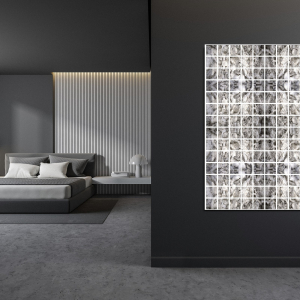
ILION (Tabula Dolii) situates the Trojan epic inside the logic of the dream: not as narration, but as a field of operations. The title proposes Ilion as a place remembered through stratified signs, while dolus (deceit, stratagem) names the specific intelligence of the Iliadic world – an intelligence that does not merely win battles, but rearranges meaning itself. In this work, Alexandru Crișan treats the epic not as an illustration to be restored, but as a classical archive to be re-coded: fractured, mirrored, and reassembled into a contemporary image-system whose primary content is interpretation. The grid is not a decorative device; it functions as a tabula – a scored surface, an architectural instrument, and a taxonomic frame. As an architect, Crișan approaches the mythic corpus the way one approaches a ruin: through measured segmentation, through controlled cuts that reveal how the whole is manufactured. The “battle” becomes legible as a syntax rather than a scene. The epic is translated into modules, and the modules become signs that migrate across the surface, producing a continual oscillation between recognition and uncertainty. This is precisely where FRAGMENTA DEORUM locates its contemporary charge: the work is less interested in what the myth says than in how myth persists as an operative structure in the visual unconscious. Read through psychoanalytic optics, dolus aligns with the dream-work itself. Freud describes dreams as condensations and displacements; here, the classical canon is treated in the same manner – compressed, rerouted, and redistributed until it no longer obeys linear storytelling. What remains is the compulsion of return: motifs and gestures recur with the insistence of the repressed. Lacan’s emphasis on the Symbolic clarifies the stakes: Ilion is not only a city in ruins, but a name that organizes desire and violence, a signifier that circulates long after its historical referent dissolves. The grid intensifies this condition: it resembles an index, yet it refuses the stability of an index. It promises ordering while staging its failure, leaving the viewer to negotiate what, exactly, is being “catalogued” – heroism, brutality, seduction, sacrifice, or the very desire to assign a single meaning. This is where Umberto Eco becomes an essential companion. ILION (Tabula Dolii) behaves as an open work: it activates a plurality of readings without collapsing into arbitrariness. The image is disciplined – architectonic, rigorous – yet semantically mobile. It invites the viewer to operate as Eco’s model reader: to mobilize an encyclopaedia of cultural memory (epic fragments, museum sculpture, archetypal forms) while remaining aware of the limits of interpretation. Dolus, in this sense, is also semiotic: it is the condition in which signs do not simply denote, but misdirect, seduce, and multiply. The work is a map of interpretive tension – between what appears to be given and what must be constructed by looking. Within the broader logic of FRAGMENTA DEORUM, ILION (Tabula Dolii) proposes a contemporary archaeology of war as an image-technology. It acknowledges that the Trojan cycle is not only a story about conflict, but a machine for producing cultural forms: the hero, the victim, the trophy, the omen, the ritual. Crișan’s recomposition does not moralize these forms; it subjects them to a new regime of visibility. The grid, like a forensic lens, both distances and intensifies. It cools the epic into analysis, while allowing its dream – residue – its erotic charge, its sacred violence, its theatre of fate – to persist as a haunting pressure beneath the surface.
> series statement:
FRAGMENTA DEORUM reexamines classical mythology through a contemporary process of visual decomposition and reassembly. In this series, Alexandru Crișan approaches the divine body not as a fixed icon but as a mutable structure – an image that can be dismantled, reorganized, and reanimated through the logic of the fragment. Trained as an architect, Crișan adopts an analytical method in which sculpture becomes material, symmetry becomes strategy, and the image behaves like a spatial system rather than a narrative scene. Each work operates within a field of controlled instability. Fragments of ancient reliefs, gestures, and anatomical details are multiplied and recomposed into new configurations where recognition and uncertainty coexist. These images provoke pareidolia: faces emerge where none were placed, mythic creatures surface from folds of marble, and bodies appear to oscillate between coherence and dissolution. Meaning does not reside in any single element but in the shifting relations among them. The series engages mythology as a psychological reservoir rather than a storytelling device. Echoes of Greek and Roman deities – Medeia, Hecate, Cassiopeia – are not depicted but inferred, surfacing through repetition, distortion, and dream-like recombination. This oneiric dimension aligns the work with psychoanalytic readings of the image, where memory, desire, and symbolic residue intertwine. The divine re-enters contemporary vision not as a stable figure but as an afterimage: a structure of intimation, erosion, and metamorphosis. FRAGMENTA DEORUM proposes that fragmentation is a generative force. Through decomposition, the sacred is not lost but redistributed; through recomposition, myth becomes newly legible. Each artwork stands as a contemporary relic, a threshold where architecture, mythology, and the unconscious converge. Crișan’s images reveal that the gods persist – not in their intact forms, but in the fragments through which they continue to speak.
> project page: FRAGMENTA DEORUM

> Special Large Collector’s Edition of 10, numbered from 1/10
> Format SL1 90CM, SL2 120cm, SL3 150cm on shortest edge
> “ILION (Tabula Dolii)” is available for purchase in one unique Art Limited Collector’s Edition of 10 and 2 Artist’s Proofs, in giclee archival art print at the highest museum quality standards, on Fine Art cotton paper from Hahnemuhle with pigment ink. The Collector’s Editions are certified signature editions, stamped and numbered on the back side. Additionally, as a separate document, a dedicated signed Certificate of Authenticity, with artwork title, date and edition number, indicate that you have purchased an original exclusive artwork. No further reproduction of any kind will be run after the collector edition is sold out. The prices for Special Large Collector Editions are progressive. For other detailed information’s see the section ART PRINTS.
Copyright © 1996-2026 Alexandru Crisan. All Rights Reserved. All photographs are the property of Alexandru Crisan. No part of the photographs or texts presented on this website may be reproduced, stored or transmitted in any form for any purpose whatsoever, whether by electronic media, photocopy, or any other means of reproduction without the written permission and/or signed consent of the author. Please read TERMS OF USE.


