

ILION R.2 (Fragmenta Dolii)
> about the image:
Non equus, non murus: sed memoria fallax. Ilion in fragmentis loquitur. Interpretatio est iter; somnus, lex.
(not the horse, not the wall: but unreliable memory. ilion speaks in fragments. interpretation is a journey; sleep, the law.)
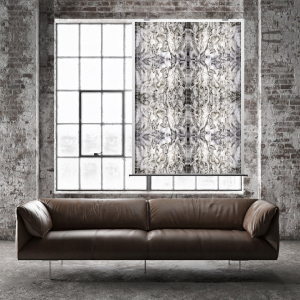
ILION R.2 (Fragmenta Dolii) approaches the same epic matter from a different psychic temperature: less “tabula” than residue, less index than afterimage. If dolus names the Trojan stratagem as cultural logic, fragmenta names its mode of survival – what remains when story fractures into sensation and myth collapses into mnemonic debris. In FRAGMENTA DEORUM, Crișan repeatedly insists that antiquity does not return as stable iconography; it returns as a disturbed field of signals. Here, Ilion is not revisited as a place, but as a pressure within the dream – an atmosphere of heroism and loss that cannot be contained by narrative closure. Without the explicit regulatory presence of the grid, the work reads as a drift of fragments held together by symmetry and repetition rather than by cataloguing. This is important conceptually: the epic is no longer presented as something we can “map”, but as something that acts on us – like a remembered scene that we cannot fully reconstruct, yet cannot forget. Freud’s notion of repetition compulsion becomes a useful frame: what returns is not the event in its historical sequence, but a patterned insistence, an affective loop. The myth persists as recurrence. Lacan would locate this persistence in the circuitry of desire: the epic becomes a theatre where the subject encounters the lure of the image – its promise of wholeness – and simultaneously the impossibility of completing it. The work refuses final synthesis; it maintains the viewer inside the labour of looking. Jung’s language of archetypes clarifies why Ilion continues to haunt: it is a reservoir of the Hero and the Shadow, of sacrificial economies and transgressive intelligence, of sacred violence and erotic proximity. Yet ILION R.2 does not “represent” these archetypes; it renders the conditions under which archetypes appear – through condensation, through mirroring, through the kind of perceptual ambiguity that produces pareidolia. Meaning is not delivered as iconographic certainty; it is generated as a phenomenology of interpretation. The viewer’s mind completes the work, not by solving it, but by moving through it. Eco’s semiotics provides a precise vocabulary for this experience. The work activates an encyclopaedia – our accumulated cultural knowledge of epic, statuary, museum space, and the visual language of authority – yet it continually interrupts any claim to definitive reading. It is open, but not random; it is plural, but not empty. The “deceit” in dolus becomes an ethics of viewing: the work teaches that images do not only show, they persuade; they do not only signify, they seduce; and they do so through structures that exceed conscious intention. In this sense, Ilion is not simply Troy; Ilion is the condition in which culture organizes itself around signs that endure precisely because they remain interpretable. As contemporary art, ILION R.2 operates as a critique and reanimation of the classical archive. It treats antiquity not as a monument to be admired from distance, but as material to be metabolized – broken, recomposed, and returned to circulation under new epistemic conditions. Crișan’s practice, grounded in architectural thinking and photographic precision, produces an image that behaves like a relic and a diagram at once: a relic because it carries the aura of a canonical past; a diagram because it exposes the mechanics by which that past continues to structure present imagination. The result is not nostalgia, but a contemporary oneiric apparatus: a work that stages Ilion as a dream of culture itself – beautiful, unstable, and persistently unfinished.
> series statement:
FRAGMENTA DEORUM reexamines classical mythology through a contemporary process of visual decomposition and reassembly. In this series, Alexandru Crișan approaches the divine body not as a fixed icon but as a mutable structure – an image that can be dismantled, reorganized, and reanimated through the logic of the fragment. Trained as an architect, Crișan adopts an analytical method in which sculpture becomes material, symmetry becomes strategy, and the image behaves like a spatial system rather than a narrative scene. Each work operates within a field of controlled instability. Fragments of ancient reliefs, gestures, and anatomical details are multiplied and recomposed into new configurations where recognition and uncertainty coexist. These images provoke pareidolia: faces emerge where none were placed, mythic creatures surface from folds of marble, and bodies appear to oscillate between coherence and dissolution. Meaning does not reside in any single element but in the shifting relations among them. The series engages mythology as a psychological reservoir rather than a storytelling device. Echoes of Greek and Roman deities – Medeia, Hecate, Cassiopeia – are not depicted but inferred, surfacing through repetition, distortion, and dream-like recombination. This oneiric dimension aligns the work with psychoanalytic readings of the image, where memory, desire, and symbolic residue intertwine. The divine re-enters contemporary vision not as a stable figure but as an afterimage: a structure of intimation, erosion, and metamorphosis. FRAGMENTA DEORUM proposes that fragmentation is a generative force. Through decomposition, the sacred is not lost but redistributed; through recomposition, myth becomes newly legible. Each artwork stands as a contemporary relic, a threshold where architecture, mythology, and the unconscious converge. Crișan’s images reveal that the gods persist – not in their intact forms, but in the fragments through which they continue to speak.
> project page: FRAGMENTA DEORUM

> Special Large Collector’s Edition of 10, numbered from 1/10
> Format SL1 90CM, SL2 120cm, SL3 150cm on shortest edge
> “ILION R.2 (Fragmenta Dolii)” is available for purchase in one unique Art Limited Collector’s Edition of 10 and 2 Artist’s Proofs, in giclee archival art print at the highest museum quality standards, on Fine Art cotton paper from Hahnemuhle with pigment ink. The Collector’s Editions are certified signature editions, stamped and numbered on the back side. Additionally, as a separate document, a dedicated signed Certificate of Authenticity, with artwork title, date and edition number, indicate that you have purchased an original exclusive artwork. No further reproduction of any kind will be run after the collector edition is sold out. The prices for Special Large Collector Editions are progressive. For other detailed information’s see the section ART PRINTS.
Copyright © 1996-2026 Alexandru Crisan. All Rights Reserved. All photographs are the property of Alexandru Crisan. No part of the photographs or texts presented on this website may be reproduced, stored or transmitted in any form for any purpose whatsoever, whether by electronic media, photocopy, or any other means of reproduction without the written permission and/or signed consent of the author. Please read TERMS OF USE.


