

CASSIOPEIA R.2 (A Deconstruction of the Mythic Body)
> about the image:
Corpus mythicum iterum disiungitur.
(the mythic body is disassembled once more)
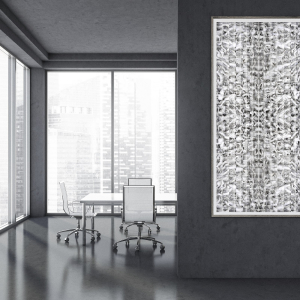
“CASSIOPEIA R.2 (A Deconstruction of the Mythic Body)” advances the logic of fragmentation introduced in the first work but pushes it toward a more radical dissolution. Here, the classical tableau is no longer merely recomposed – it is algorithmically destabilized, atomized into an extended lattice of ornamental repetition that echoes both the obsessive symmetries of Byzantine patterning and the recursive logic of contemporary image-processing. The mythic body becomes unlocatable. Cassiopeia, Andromeda, Perseus, the monstrous Cetus, the imploring warriors and contorted nudes: none remain as identifiable protagonists. Instead, their sculptural anatomies are subjected to a systemic decomposition that reveals the underlying structural violence of myth itself. Every limb, shield, drapery fold, and petrified gesture becomes a unit in a larger visual equation, repeated until meaning fractures into pure ornament. In this expanded matrix, the heroic relief mutates into something closer to a field of psychoanalytic projection. The eye searches for narrative anchors – faces, conflicts, arcs of salvation or punishment – but finds only echoes, distorted beyond recognition. Cassiopeia’s celestial inversion becomes a metaphor for image inversion: a myth turned inside out, rearticulated as pattern rather than story. Where the first work still retains traces of sculptural depth, R.2 introduces a near-cartographic flatness. The mythic landscape is stretched, mirrored, extended – a marble tapestry that anticipates its own digital afterlife. The decomposition is not destructive but methodological. It reveals the mythic body as a cultural construct: iterable, editable, endlessly rewriteable. In this sense, the work enters into dialogue with the 20th and 21st-century artistic interrogations of the classical canon – from deconstructive postmodern sculpture to conceptual photography that challenges the authority of historical form. What emerges is not the collapse of antiquity but its reconfiguration. Myth survives here not as narrative fidelity, but as aesthetic residue, carried into the contemporary through repetition, distortion, and formal excess. “Cassiopeia R.2” is less a depiction than an exposure. It reveals the architecture of mythology: ornamental, violent, erotic, and profoundly unstable. A mythic body taken apart so that its mechanisms – cultural, psychological, and visual – can finally be seen.
> series statement:
FRAGMENTA DEORUM reexamines classical mythology through a contemporary process of visual decomposition and reassembly. In this series, Alexandru Crișan approaches the divine body not as a fixed icon but as a mutable structure – an image that can be dismantled, reorganized, and reanimated through the logic of the fragment. Trained as an architect, Crișan adopts an analytical method in which sculpture becomes material, symmetry becomes strategy, and the image behaves like a spatial system rather than a narrative scene. Each work operates within a field of controlled instability. Fragments of ancient reliefs, gestures, and anatomical details are multiplied and recomposed into new configurations where recognition and uncertainty coexist. These images provoke pareidolia: faces emerge where none were placed, mythic creatures surface from folds of marble, and bodies appear to oscillate between coherence and dissolution. Meaning does not reside in any single element but in the shifting relations among them. The series engages mythology as a psychological reservoir rather than a storytelling device. Echoes of Greek and Roman deities – Medeia, Hecate, Cassiopeia – are not depicted but inferred, surfacing through repetition, distortion, and dream-like recombination. This oneiric dimension aligns the work with psychoanalytic readings of the image, where memory, desire, and symbolic residue intertwine. The divine re-enters contemporary vision not as a stable figure but as an afterimage: a structure of intimation, erosion, and metamorphosis. FRAGMENTA DEORUM proposes that fragmentation is a generative force. Through decomposition, the sacred is not lost but redistributed; through recomposition, myth becomes newly legible. Each artwork stands as a contemporary relic, a threshold where architecture, mythology, and the unconscious converge. Crișan’s images reveal that the gods persist – not in their intact forms, but in the fragments through which they continue to speak.
> project page: FRAGMENTA DEORUM

> Special Large Collector’s Edition of 10, numbered from 1/10
> Format SL1 90CM, SL2 120cm, SL3 150cm on shortest edge
> “CASSIOPEIA R.2 (A Deconstruction of the Mythic Body)” is available for purchase in one unique Art Limited Collector’s Edition of 10 and 2 Artist’s Proofs, in giclee archival art print at the highest museum quality standards, on Fine Art cotton paper from Hahnemuhle with pigment ink. The Collector’s Editions are certified signature editions, stamped and numbered on the back side. Additionally, as a separate document, a dedicated signed Certificate of Authenticity, with artwork title, date and edition number, indicate that you have purchased an original exclusive artwork. No further reproduction of any kind will be run after the collector edition is sold out. The prices for Special Large Collector Editions are progressive. For other detailed information’s see the section ART PRINTS.
Copyright © 1996-2026 Alexandru Crisan. All Rights Reserved. All photographs are the property of Alexandru Crisan. No part of the photographs or texts presented on this website may be reproduced, stored or transmitted in any form for any purpose whatsoever, whether by electronic media, photocopy, or any other means of reproduction without the written permission and/or signed consent of the author. Please read TERMS OF USE.


