ODYSSEIA (Tabula Gorgonis)
> about the image:
Monstrum est signum quod somnus legit.
(a monster is a sign that sleep can read – fragmentum apocryphum)
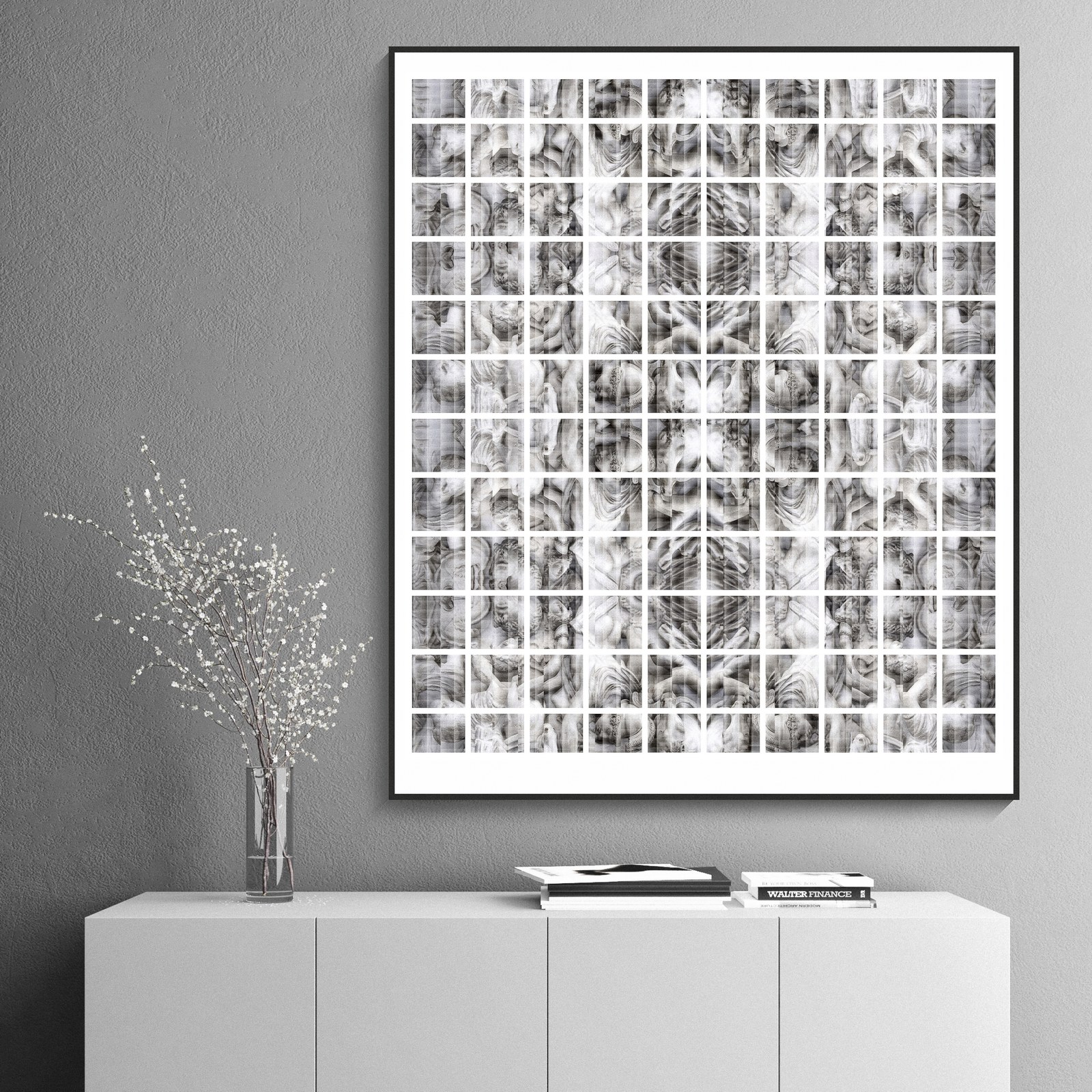
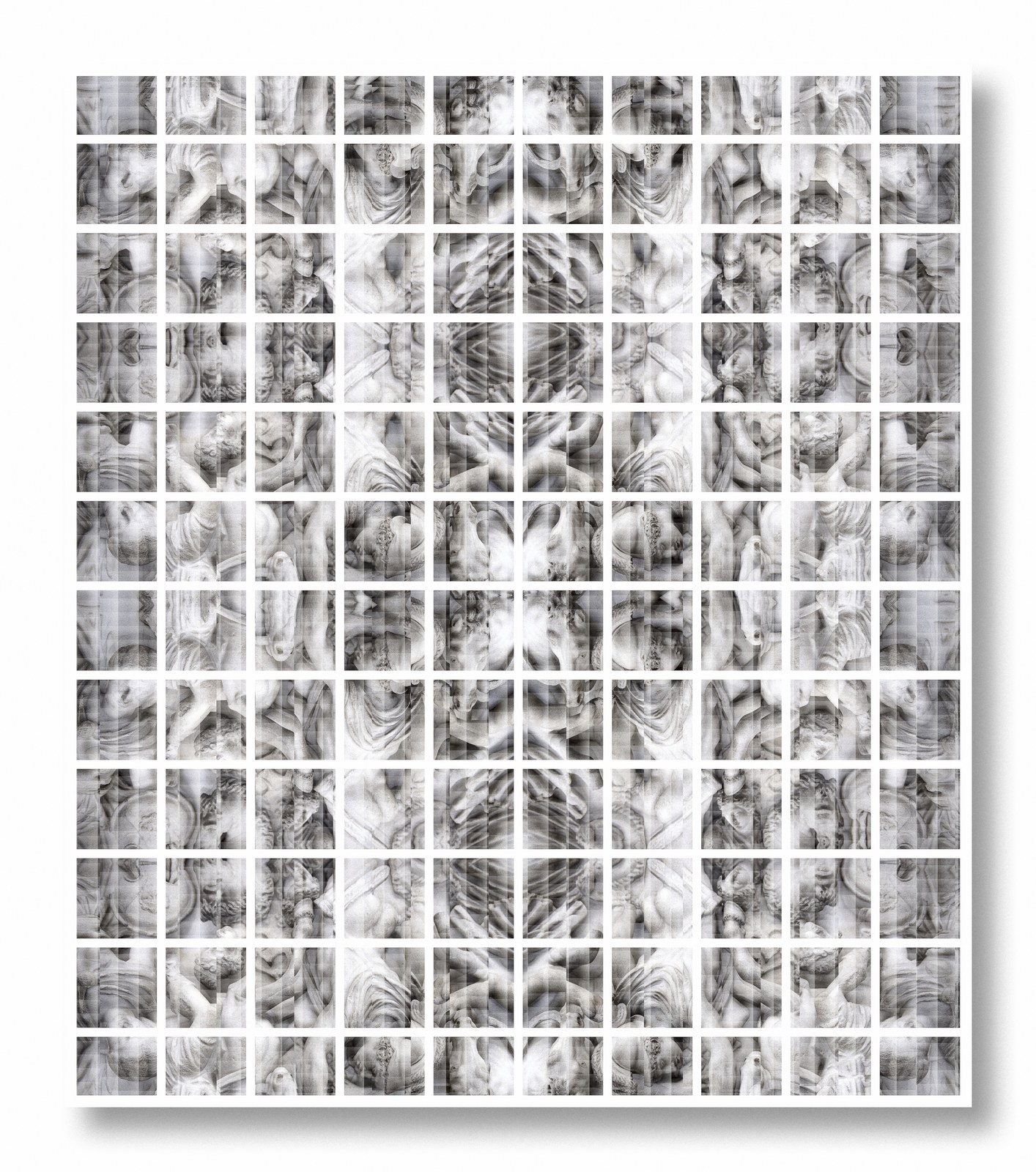
ODYSSEIA (Tabula Gorgonis) positions the Homeric voyage as a psychological structure rather than a narrative itinerary. In the classical tradition, the journey is never only geographic; it is a machine for transformation, a theatre in which identity is dismantled and reassembled under the pressure of trials, prohibitions, seductions, and returns. In this work, that itinerary is translated into an image-logic governed by dream: not linear progression, but recurrence; not explanation, but condensation; not stable meaning, but a field of shifting correspondences. The subtitle Tabula Gorgonis frames the work as an epistemic plate: a surface that does not “tell the story” but catalogues its forces. The Gorgon here functions less as a mythological character and more as a structural limit within representation itself. In Greco-Roman iconography, the gorgoneion is both protective and catastrophic: a sign placed on armour and thresholds to repel harm, yet also a sign that arrests the viewer – an emblem of the gaze that cannot be endured without consequence. In psychoanalytic terms, this double function is crucial. The Gorgon condenses attraction and interdiction, Eros and Thanatos, into a single figure of symbolic intensity. It marks the point where desire approaches what it cannot assimilate. Freud’s account of dream-work clarifies the operative mechanism. Dreams do not invent ex nihilo; they reorganise. They condense disparate residues into composite forms, displace affect onto substitute images, and produce a manifest surface that both reveals and conceals the latent logic beneath it. ODYSSEIA (Tabula Gorgonis) advances this principle as method. Classical sculpture – already a cultural memory-object, already a residue – becomes further decomposed and recomposed until it behaves like a dream-text: legible, yet never exhausted by a single reading. The grid operates as a rationalising screen: an architectural device that imposes order while simultaneously emphasising fragmentation, as if the image were being held together by an analytic framework that cannot fully stabilise what it contains. The work also permits a Lacanian reading of the gaze. What returns in the “Gorgon” is not merely the fear of looking, but the anxiety of being looked at by the image – by the symbolic itself. The viewer’s interpretive impulse, the desire to fix meaning, meets a surface that continually redistributes signifiers. Myth becomes a language that refuses closure. The Odyssey’s core motif – return – reappears here as psychic compulsion: a repeated circling around an unresolved kernel. In Jungian terms, the work activates archetypal material not as illustration but as structure: the Shadow as what is repudiated yet persistent; the threshold as what divides the civilised from the monstrous; the voyage as individuation performed through fracture rather than harmony. ODYSSEIA (Tabula Gorgonis) therefore functions as contemporary archaeology in a strict sense: it excavates not “antiquity” but the psychic infrastructure antiquity continues to supply. It is contemporary art precisely because it treats the classical canon as a living archive—mutable, reprogrammable, susceptible to reconfiguration under modern perceptual and theoretical conditions. The image does not ask the viewer to recognise a scene; it asks the viewer to recognise a mechanism: how myths persist when belief has dissolved, how forms survive as afterimages, how the sacred returns as a semiotic disturbance inside the dream.
> series statement:
FRAGMENTA DEORUM reexamines classical mythology through a contemporary process of visual decomposition and reassembly. In this series, Alexandru Crișan approaches the divine body not as a fixed icon but as a mutable structure – an image that can be dismantled, reorganized, and reanimated through the logic of the fragment. Trained as an architect, Crișan adopts an analytical method in which sculpture becomes material, symmetry becomes strategy, and the image behaves like a spatial system rather than a narrative scene. Each work operates within a field of controlled instability. Fragments of ancient reliefs, gestures, and anatomical details are multiplied and recomposed into new configurations where recognition and uncertainty coexist. These images provoke pareidolia: faces emerge where none were placed, mythic creatures surface from folds of marble, and bodies appear to oscillate between coherence and dissolution. Meaning does not reside in any single element but in the shifting relations among them. The series engages mythology as a psychological reservoir rather than a storytelling device. Echoes of Greek and Roman deities – Medeia, Hecate, Cassiopeia – are not depicted but inferred, surfacing through repetition, distortion, and dream-like recombination. This oneiric dimension aligns the work with psychoanalytic readings of the image, where memory, desire, and symbolic residue intertwine. The divine re-enters contemporary vision not as a stable figure but as an afterimage: a structure of intimation, erosion, and metamorphosis. FRAGMENTA DEORUM proposes that fragmentation is a generative force. Through decomposition, the sacred is not lost but redistributed; through recomposition, myth becomes newly legible. Each artwork stands as a contemporary relic, a threshold where architecture, mythology, and the unconscious converge. Crișan’s images reveal that the gods persist – not in their intact forms, but in the fragments through which they continue to speak.
> project page: FRAGMENTA DEORUM

> Special Large Collector’s Edition of 10, numbered from 1/10
> Format SL1 90CM, SL2 120cm, SL3 150cm on shortest edge
> “ODYSSEIA (Tabula Gorgonis)” is available for purchase in one unique Art Limited Collector’s Edition of 10 and 2 Artist’s Proofs, in giclee archival art print at the highest museum quality standards, on Fine Art cotton paper from Hahnemuhle with pigment ink. The Collector’s Editions are certified signature editions, stamped and numbered on the back side. Additionally, as a separate document, a dedicated signed Certificate of Authenticity, with artwork title, date and edition number, indicate that you have purchased an original exclusive artwork. No further reproduction of any kind will be run after the collector edition is sold out. The prices for Special Large Collector Editions are progressive. For other detailed information’s see the section ART PRINTS.
Copyright © 1996-2026 Alexandru Crisan. All Rights Reserved. All photographs are the property of Alexandru Crisan. No part of the photographs or texts presented on this website may be reproduced, stored or transmitted in any form for any purpose whatsoever, whether by electronic media, photocopy, or any other means of reproduction without the written permission and/or signed consent of the author. Please read TERMS OF USE.