BATRA
Transylvania Architecture Biennial 2025, Cluj-Napoca
ARCHITECTURE PHOTOGRAPHY
NATIONAL ARCHITECTURE COMPETITION AND EXHIBITION / CLUJ-NAPOCA 2025 ROMANIA

BIENALA DE ARHITECTURA TRANSILVANIA 2025
“2 Get There, CT-II-m-A-02872“
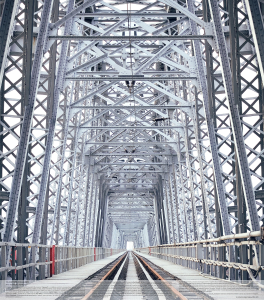
2 GET THERE, CT-II-m-A-02872
by PhD.Arch. Alexandru Crișan 2023
Accept my slang for the attempted pun in the title, because “together” is a nourishing embrace of our everyday cosmopolitan! I am talking about the “cosmopolitan” in architecture, speaking, in fact, about the emancipation of this term, haunted by a pejorative accent, stamped with populist generosity by proletcultist propaganda on any creation it has laid hands on. And I am also talking in this photograph about an eminently inclusive architectural act, conceived by a Romanian engineer of Franco-Polish origins (Anghel Saligny), originally named in honor of a Romanian born in Sigmaringen (Carol I), ennobled by a French sculptor (Léon Pilet) with the monumentality of Romanian soldiers known under a name of Slavonic etymology (dorobanți). Such a natural diversity for our “middle” of the world, and therefore so functional & (sic!) durable (despite some Soviet bombings…)! After all, I took this photo with a work by Paul Gauguin in mind.
Of course, being an architect, the result doesn’t really resemble the source of inspiration… But “D’où venons-nous? Que sommes-nous? Où allons-nous?” are the questions to which the CERNAVODĂ BRIDGE offered, I believe, a unified answer, which encloses within it the quintessence of architectural praxeology: we build to get together where we want to, to stay together, to measure time together. Of course, being an architect, I know well that a bridge is more than a metaphor: it unites two languages of land, nothing more, nothing less; related metonymies belong to poets. But it also unites two complementary professions: that of architect and that of engineer. Today, when they are no longer confused with each other, when overspecialization is crippling them, only the passage of time impartially measures their almost incestuous performances. At the end of the 19th century, work was individual. At the end of the 20th century, work was team work. The end of the 21st century will probably cement the dominance of the algorithm born of a sterile database handled by “A.I.” with compiler dexterity. So, in this photograph (art that is already a sedated vat of algorithms) I am talking about Anghel Saligny, because I am afraid that the students of my students will plagiarize him without their will. Because, after all, “it is only” a bridge, right?
It’s just that our gaze runs, like in Gauguin’s painting, from one angle to another, and we see that we are, in fact, unfolding time. And thus we give it meaning: because we show that we have arrived where we wanted to be, and we are together. Could an architect ask for more? Just a bridge… whose justification was the joy of a reunited Romania. And the confirmation of its soul was not political or conjunctural-industrial, but its being, simply, in guaranteeing the reliability, including the resistance of this bridge over the Danube. How could we not remember here the team of engineers who stood with Anghel Saligny under the bridge, at its inauguration, to show, perhaps, that together means trust? The cantilever beams and the soft steel for the decks thus become banal plagiarizable details of a “simple bridge” that was to unite – via accessibility and speed – the Romanian Country of Dobrogea, barely recovered after the Treaty of Berlin. And to unshakably join them, like a silver rivet.
PS: “The Carol I Bridge with the “Dorobanții” statues is listed in the list of historical monuments under the code CT-II-m-A-02872”.
In memoriam Anghel Saligny (1854-1925)
BIENALA DE ARHITECTURA TRANSILVANIA 2025
“Leisure Now, Re-Recovered“

LEISURE NOW, RE-RECOVERED
by PhD.Arch. Alexandru Crișan 2021
If architecture is to be understood as the combination of “empty”, quantifiable space, with “full”, recognisable space, then a good part of it is the science of proportions and the art of memory. When we see leisure architecture, when we give it a whirl, when, fortuitously, we clarify it, we often ignore its proportions, but, many times, we prepare it from the first sight for affective recontextualization. Then, if we have a bit of luck, time catches up with us; sometimes, we call this transition, so as not to miss the obsession with the arrival point-axis. It is clear, “we are going through a period…”, so we should embrace our detachment. We do it because we are – obviously! – self-sufficient, in our re-configurable regularity. But sometimes, over the superficiality (a revolt against proportions, in fact) and the alienation (a consequence of memory, in fact) of our adaptations to everyday life, something else is added. And because any name means reputation, we say: COVID-19! A scourge that, drop by drop, pushes us over the vastness of our spatial emptiness, and therefore over the alienation – perhaps even over the loneliness – of the metropolis.
Gone is the snarling “longing” for ornament, but also the disproportionate impulse to domesticate it! Minimalism is now a shell of safety, a haven of contemplation and enlightenment, the truth beyond panic and calm… Minimalism is frozen in time, because we have frozen time – now, even beyond photography! We breathe with a hiss in this empty space, pierced only by the rotten ruins of days with familiar amplitudes, on the like4share alert for the rediscovery of (in)voluntary autobiographical landmarks: “here I stayed last summer with Her”… “there I tied up the dog”… “here I was about to drown 3 years ago”…
This fragmentarium saturated with melting-milky lights recomposes the elements of identification (here, there, a year ago, four months ago…) in a quasi-symmetrical, but disproportionate way, because the trauma of fictional memories has sickeningly conquered our boredom. We dream, after all, like Marcel Proust: “I find very wise that Celtic belief which tells us that the souls of those we have lost are captive in some inferior being, in an animal, a plant, an inanimate thing, truly lost to us until the day, which for many never comes, when we happen to pass by the tree, when we enter into the possession of the object in which they are imprisoned. Then they startle, they call us, and, as soon as we have recognized them, the spell is broken. Freed by us, they have defeated death and come back to live with us.” (À la recherche du temps perdu. Du côté de chez Swann. Gallimard, 1919, anonymous translation)
However, let us not deceive ourselves: the minimalist of avarice lurking through the reptilian brain is the survivor. But he does not dream, but converts the lost leisure into functional affective comfort. He builds synchronicity from simplified proportions, enclosing the constructed space through the dungeons of memories. He will probably dictate to us the sine qua non of the post-pandemic architectural act.
BIENALA DE ARHITECTURA TRANSILVANIA 2025
“Schesis“
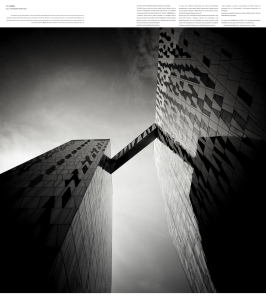
SCHESIS
by PhD.arh. Alexandru Crișan 2018
“And love is nothing more than a name for our passionate desire to be whole again. Whole as I said we were from the beginning and not divided in our own being, split, for our presumptuousness, by Zeus […]. It is, therefore, to be feared that if we sin against the gods, we will be split once again, like firebrands, so that we walk, like people who are seen in profile, in bas-relief, on tombstones, cut from top to bottom along the line of the nose.” (Plato, The Banquet, translation by Petru Creția, Humanitas, 2011, 192e-193a, pg. 116)
This is not a fortuitous photograph.
This is a conspiracy. Since I have known it, my city has been gradually re-calculating its heels, in a concert of the contingencies of post-communist convalescence. It is a citadel in which together it seems to have calibrated its ideal via Brâncuși’s “The Kiss”, in a calm desperation, in a measured eroticism; it is completed by a grip synonymous with a trap, only that its “signalectic” seems stingy and hungry, begging for an anachronistic lighting. It is hard to find architectural arms that unite landmarks and points of view!
This is not a photograph of my city.
In my city, the architectural details are aortic. Metropolitan peristalsis is a barcode scarred in decayed concrete. Living spaces only have sweat glands. Office buildings only have deltoids. Somehow, the two typologies only touch their pelvises.
This is, however, a functional architectural detail photo in which together means a sought-after, non-delicate, yet anti-gravitational touch, which allows for a synchronized vertigo: two resistance structures that seem to tense each other at a 15-degree angle, with an extended epidermis that parametrically sinks towards a Scandinavian sun with canines, and which allows for an inclusive transfer of penumbra, but does not approve of confusing crowding with intimacy.
This is an architectural detail photo: Bella Sky Hotel, built by 3XN in Ørestad, Copenhagen.
PS: – schesis s [At: VĂCĂRESCUL. IST. 289 / Pl: ? / E: ngr σχέσις] (Grî) Relationship established between things, facts, events, etc. (cf. dexonline.ro)
– conspiracy (etymology): con = together, spirare = to breathe
BIENALA DE ARHITECTURA TRANSILVANIA 2025
“CORBU #1 Ronchamp V.2.0”
( BATRA AWARD )
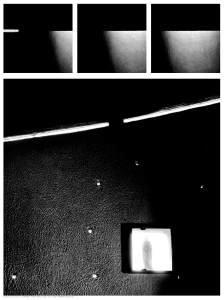
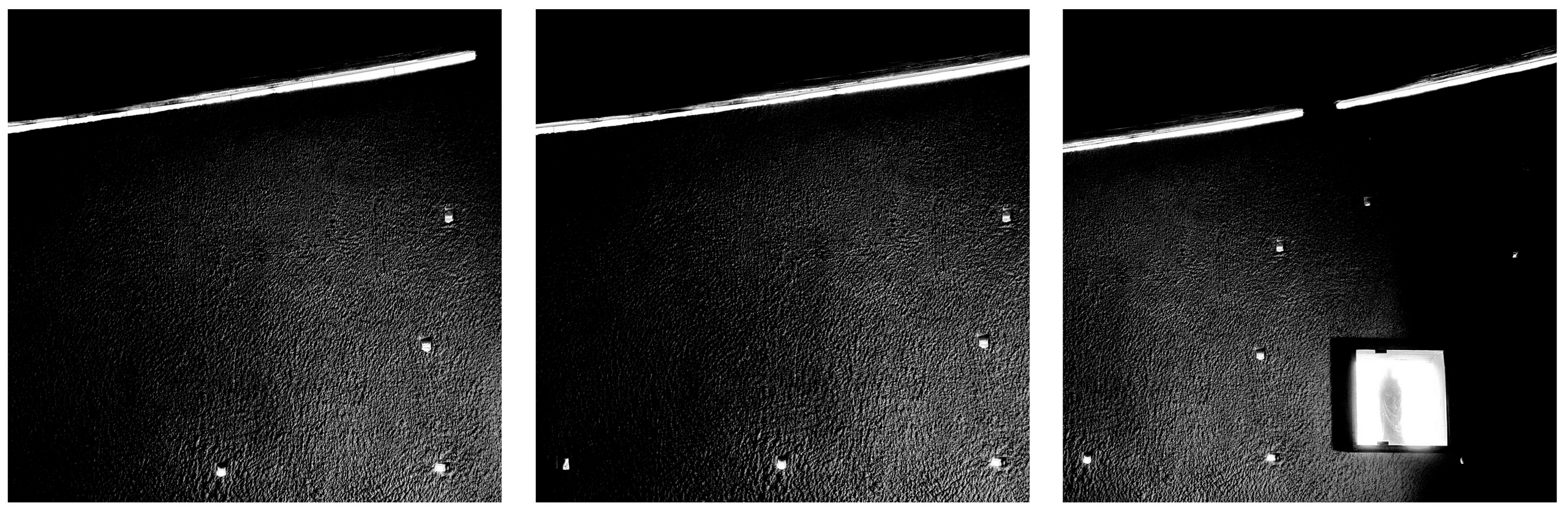
CORBU #1 Ronchamp V.2.0
by PhD.arch. Alexandru Crișan 2011
“Talking about Le Corbusier and the perception of the architectural object translates to look beyond the generalized image in an individual, personalized space, causing a state of timelessness … a sensation that can often be transposed into the gradual precept within the temporal of causal space conforming architectural. Timelessness is not measured … Sometimes along this route, predetermined or directed, you experience the demiurgical feeling of rebuilding the interior space. Perception results from summing up and superimposing the assimilation of elements. It can often surprise you later, through the remembrance of cumulative sensations. In this context, the memory and the ability to join sequences in a chronological order plays an essential role … The constituent fragments of a whole, re-evaluated beyond seeming punctual, create the illusion of an integral object by recomputing a specific scene. Fragments redefine the limits a priori perceived, and most of the time redirecting your attention causes you to choose a different route different from the one originally proposed.” (read more on “White.Black? Corbu’ Part 2“: https://alexandru-crisan.com/black-corbu-2-on-arhitectura-magazine-2012-bucharest-romania/)
“Determining space through the complex game of shadows generated by the light flux is the attribute of the metaphysical architectural object. The game caused by the violent contrast between the shadow and the light re-constructs the perceptible field space. Light that creates space is one of the attributes of Le Corbusier’s specially operating element. Light is mediated by the architectural object that assumes it, incorporating it into all the constituent elements. It performs the subtle metaphysical transition between inner space and outer space. Light, a volume modeling tool, helps define the spatial orientation of objects. Concentrated light resulting from the orientation of the architectural elements of the windows draws guidelines that unify the elements of the interior space. The complex geometric composition translates beyond the sensations into an identity message.”
“The spatial perception of the light drawing resulting from the contrast generated by the Ronchamp traspore highlights the separation between two worlds: the outer space world determined by the presence of light and the inner space world dominated by darkness, by the clearobscur generated by the perforated element. Darkness partially rebuilds interior elements by accentuating their quality of light absorption and reflecting their own brightness. Objects passively receive light, becoming light sources themselves. The distinction between white and black becomes somewhat imperceptible. Absolute black is the element highlighted by the presence of intense whiteness.” (read more on “White. Corbu’ Part 1“: https://alexandru-crisan.com/white-corbu-1-on-arhitectura-magazine-2012-bucharest-romania/)
BIENALA DE ARHITECTURA TRANSILVANIA 2025
“π (3.14159 26535 89793)“
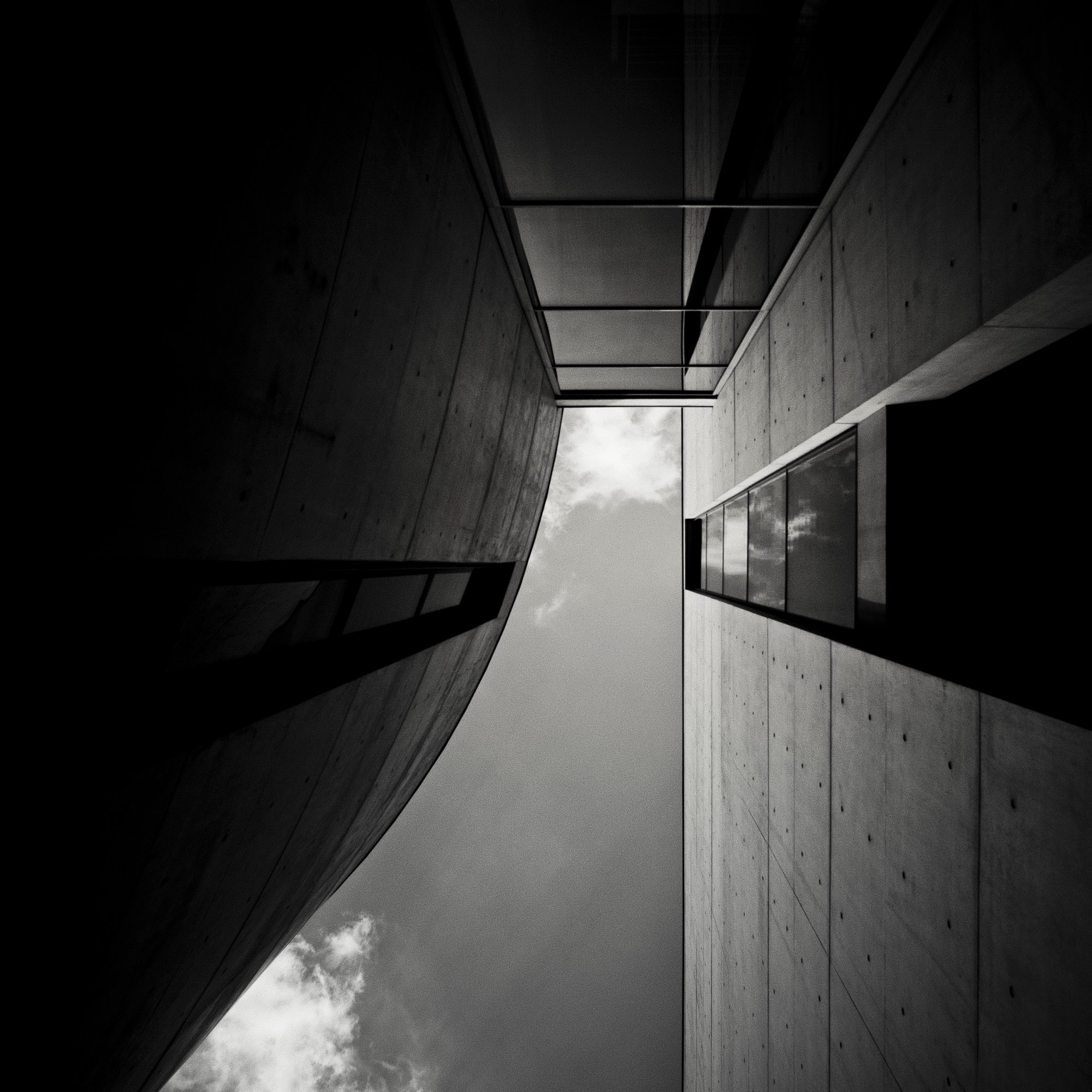
π (3.14159 26535 89793)
by PhD.arch. Alexandru Crișan 2018
π (3.14159 26535 89793)
Artist Bio/CV
Alexandru Crișan (b. Bucharest, Romania 1978) is a visual artist interested in the existential complementarity of objective and nonobjective forms of expression. To resolve the former, he is an architect. As far as the latter is to be unpacked, his “counter-professional” career in photography began in 2008; his paintings stand, for almost three decades, as the most intimate, borderline atavistic, acts of divulgence. Assuming that taxonomy is of any consequence, he is partial to fine-art photography and Abstract Expressionism. The eclectic nature of his projects is, therefore, a given. Crișan’s works have been presented in over a dozen international exhibitions, have been published in over 50 peer-reviewed magazines, have received over 500 international awards and nominations, and are part of several privately owned collections and art galleries.
